
Our loan repayment calculator is the most-used tool on this site, and I suspect most people use about a tenth of it. They type in a loan amount, look at the monthly figure, and close the tab.
That monthly number is the least interesting thing the calculator produces. Here is how to get the rest.
The Four Inputs, and What Each One Actually Changes
Loan amount
The amount you are borrowing — the purchase price minus your deposit. Not the property price. If you are buying at $850,000 with a $150,000 deposit, enter $700,000.
Worth remembering that your deposit also has to cover stamp duty and other upfront costs, unless you are exempt. Our stamp duty calculator will tell you where you stand there, and our guide to NSW first home buyer costs covers the exemptions.
Interest rate
Enter the rate you expect to actually pay. A useful habit: run the numbers a second time at a rate one to two percentage points higher. Not because that is a forecast, but because it tells you where your own comfort limit sits.
Loan term
This one has more impact than people expect, in both directions. A longer term lowers the repayment and raises the total interest — sometimes dramatically. Run 25 years and 30 years on the same loan and compare the total interest figures. The gap is usually eye-opening.
Repayment frequency
Monthly, fortnightly or weekly. This is the input that is most often misunderstood, so it gets its own section below.
What It Looks Like Filled In
If you have never used one of these before, here is the calculator with a real scenario entered — a $700,000 loan at 6.00 per cent over 30 years, paid monthly.
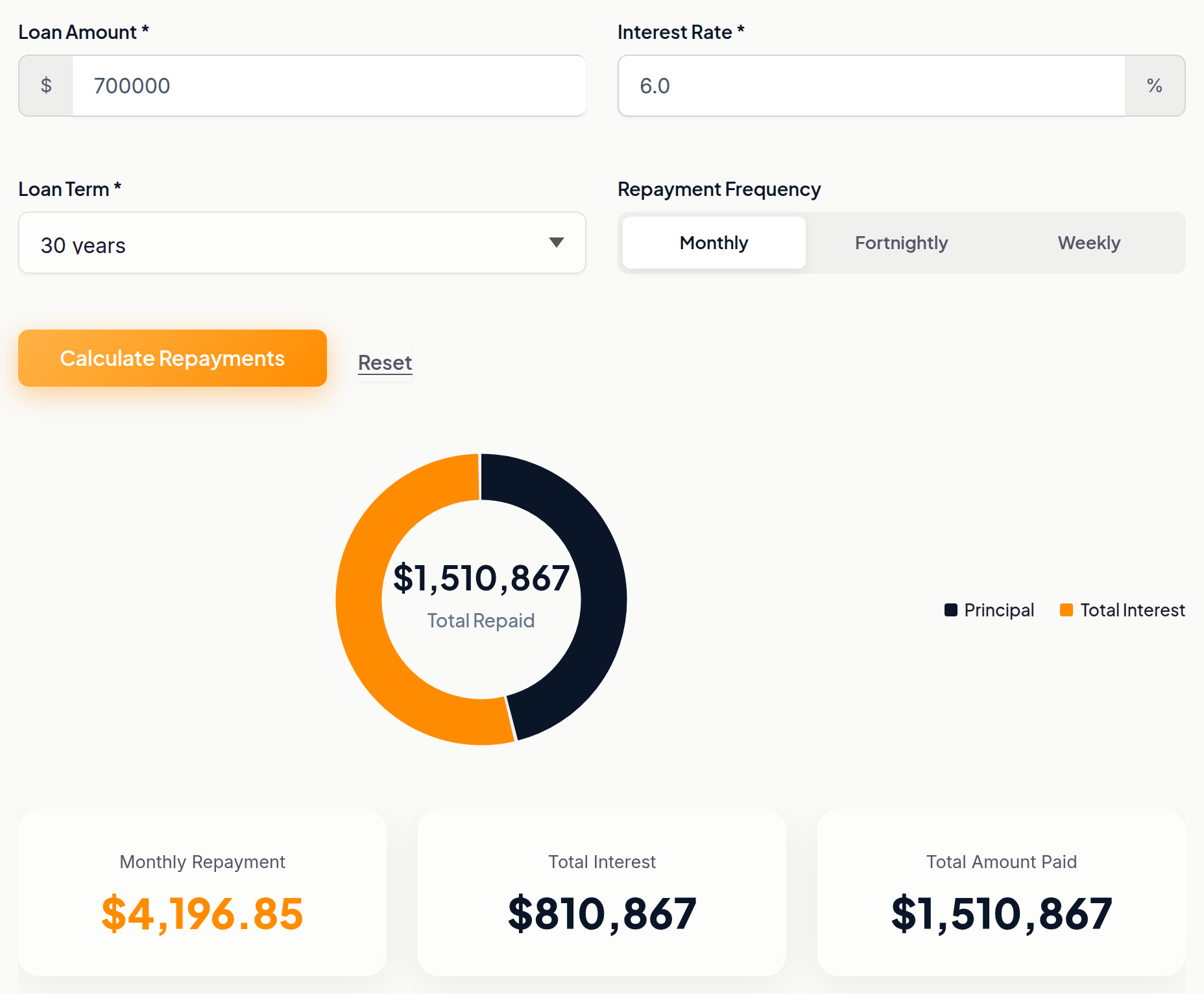
Reading it from the bottom up, because that is where the answers are:
- Monthly Repayment — $4,196.85. This is the figure most people come for. It is what leaves your account each month.
- Total Interest — $810,867. What you pay the lender for the privilege of borrowing, across the full 30 years.
- Total Amount Paid — $1,510,867. The loan plus the interest. This is what the house actually costs you in repayments.
The doughnut chart in the middle shows the same thing visually: the dark segment is the $700,000 you borrowed, the orange segment is the $810,867 of interest. Seeing those two side by side is usually the moment it clicks for a first home buyer — the interest is larger than the loan.
That is not a reason to panic, and it is not unique to this loan. It is simply what borrowing a large sum over three decades costs. But it does explain why the rest of this article focuses on the levers that shift that orange segment.
The Fortnightly Option Is Not What You Think
When you select “fortnightly”, the calculator divides your annual repayment total by 26. It is showing you the equivalent fortnightly amount — the same dollars per year, sliced differently. On a $700,000 loan at 6.00 per cent that is $1,937.01, against a monthly repayment of $4,196.85.
Notice it is less than half the monthly figure. That is the giveaway, and it is why the loan still runs the full 30 years.
The version that actually works is paying half your monthly repayment every fortnight — $2,098.43 — which sneaks in a thirteenth monthly repayment each year and clears the loan five and a half years early. We work through all five schedules, and why weekly behaves the same way, in weekly, fortnightly or monthly repayments, which has a calculator built for exactly this comparison.
The Number That Should Actually Get Your Attention
Not the repayment. The total interest.
On a $700,000 loan at 6.00 per cent over 30 years, you repay about $1,510,867. Of that, $810,867 is interest — more than the amount you borrowed.
I am not raising this to alarm anyone. It is simply how long-term amortising debt works, and it is the reason that small changes — a slightly better rate, a shorter term, an offset balance, one extra payment a year — compound into very large numbers over three decades.
Reading the Amortisation Schedule
The calculator includes an amortisation schedule, which most people never expand. It is worth thirty seconds of your time, because it shows the single most counter-intuitive fact about mortgages.
On that same $700,000 loan, your very first repayment of $4,197 splits like this:
- $3,500 interest — 83 per cent of the payment
- $697 principal — 17 per cent
Click “View Yearly Amortisation Schedule” and you can see that play out year by year:
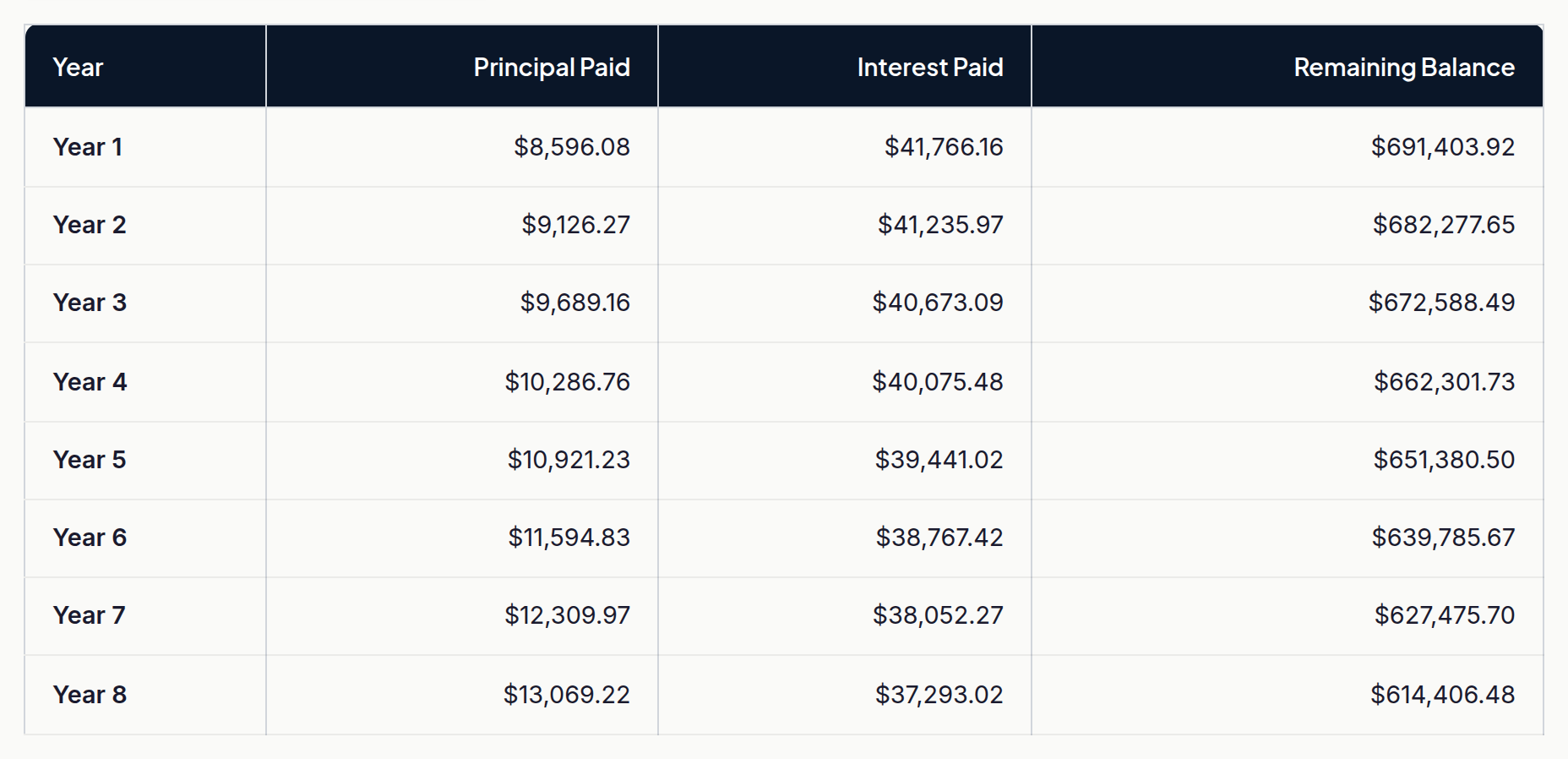
Read the Year 1 row across. You pay $41,766 in interest and only $8,596 comes off the loan. After twelve months of repayments totalling roughly $50,000, your balance has gone from $700,000 to $691,404.
For a first home buyer this is often the most useful thing on the page, because it corrects a very common assumption. People expect the balance to fall in a straight line. It does not. Look at the Principal Paid column: $8,596 in year one, rising to $13,069 by year eight. The amount coming off your loan grows every single year, while the interest steadily shrinks.
By Year 8 you have paid around $400,000 in repayments and the balance sits at $614,406. That feels slow, and it is — but the curve is working in your favour the whole time, and it accelerates.
Interest is charged on the outstanding balance, so early on — when the balance is at its highest — almost all of your payment services interest. The ratio flips gradually, and only in the final third of the term does the bulk of each payment start reducing what you owe.
Why this matters practically
Two things follow from it:
Extra repayments are worth far more early than late. An extra $10,000 in year two removes that principal from every subsequent interest calculation for 28 years. The same $10,000 in year 25 saves comparatively little. If you are ever going to get ahead on your loan, the beginning is when it counts.
Refinancing back to a fresh 30-year term resets the clock. If you refinance after seven years into a new 30-year loan, you drop back to the front of the curve where payments are mostly interest. A lower rate can still be worth it — but ask about keeping the remaining term rather than restarting at 30 years. Our refinancing page explains how we assess that.
How I Use It With Clients
Three runs, in this order:
- At your expected rate — is this repayment comfortable, honestly?
- At two percentage points higher — could you sustain that for a year or two?
- At a shorter term — what does 25 years cost per month, and how much total interest does it save?
If you are still working out what repayment your income actually supports, start with the pay and income tax calculators — a lender assesses your gross income, but you repay the loan from what lands in your account.
If run two makes you uneasy, the answer is usually to borrow less rather than to hope. The 3 per cent buffer that lenders are required to apply exists for the same reason — we cover how that works in what lenders actually assess.
And if you are weighing certainty against flexibility, our guide to fixed versus variable works through the trade-offs.
Frequently Asked Questions
What loan amount should I put into a mortgage repayment calculator?
Enter the amount you are actually borrowing, which is the purchase price minus your deposit, not the property price. If you are buying at $850,000 with a $150,000 deposit, enter $700,000. Remember your deposit usually also has to cover stamp duty and other upfront costs unless you are exempt, which you can check on the stamp duty calculator.
How much interest will I pay on a $700,000 home loan?
At 6.00 per cent over 30 years with monthly repayments of $4,196.85, you would pay about $810,867 in interest, making the total repaid around $1,510,867. The interest is larger than the amount borrowed. That is normal for a large loan over three decades, and it is why a better rate, a shorter term, an offset balance or extra repayments make such a big difference.
Why does my mortgage balance go down so slowly at the start?
Interest is charged on the outstanding balance, so when the balance is highest, most of each repayment goes to interest. On a $700,000 loan at 6.00 per cent, the first $4,197 repayment is about $3,500 interest and only $697 principal. After year one the balance is $691,404. The principal portion grows every year, and only in the final third of the term does most of each payment reduce what you owe.
Is it better to make extra mortgage repayments early or later in the loan?
Early, by a wide margin. An extra $10,000 paid in year two comes off the balance that every later interest calculation is based on, so it keeps saving you interest for the remaining 28 years. The same $10,000 paid in year 25 saves comparatively little. If you are going to get ahead on your home loan, the first years are when it counts most.
Does refinancing reset my mortgage term?
It can. If you refinance after seven years into a new 30-year loan, you go back to the start of the amortisation curve, where repayments are mostly interest. A lower rate can still make refinancing worthwhile, but it is worth asking the new lender about keeping your remaining term rather than restarting at 30 years, so the lower rate is not offset by years of extra interest.
What a Calculator Cannot Tell You
It assumes one rate for the whole term, which will not happen. It does not account for offset balances, annual fees, LMI, or the fact that your lender’s advertised rate may not be the rate you are offered.
Use it to compare scenarios against each other, not to predict the future. The relative answers are reliable; the absolute ones are an estimate.
If part of what you are weighing up is rolling other debts into the loan, our guide to the debt consolidation calculator works through when that helps and when it quietly costs you.
Want to talk through what this means for your situation? Call David on 0417 676 191 or get in touch via our contact form.
This article is general information only and does not take into account your objectives, financial situation or needs. Figures are illustrative and current as at the date of publication. Interest rates, lender policies and government scheme rules change — please seek advice specific to your circumstances before acting.
Ready to move forward?
Have questions about anything in this article? David from Rebus Finance can help with a free, no-obligation chat.