
Our debt consolidation calculator answers a very specific question: if I rolled these debts into one loan at a lower rate, what would my monthly repayment be, and how much would I save each month?
It answers that accurately. But the monthly saving is only half the story, and the half it leaves out is the one that costs people money. Here is how to use the tool so you see the whole picture.
How the Calculator Works
You enter each existing debt — a name, the balance, its interest rate, and the minimum monthly payment. Add as many as you need: credit cards, personal loans, car finance, buy-now-pay-later balances.
Then you enter the details of the consolidated loan: the new interest rate and the loan term.
The calculator compares your current total monthly commitment against the new single repayment, and shows the difference.
That loan term field is where the real decision lives, and it is the one most people never change.
A Worked Example
Take a fairly typical set of debts:
| Debt | Balance | Rate | Minimum payment |
|---|---|---|---|
| Credit card | $12,000 | 19.9% | $300/mo |
| Personal loan | $18,000 | 12.5% | $450/mo |
| Car loan | $25,000 | 8.9% | $520/mo |
| Total | $55,000 | $1,270/mo |
Left alone and paid at those minimums, these debts clear in roughly four to six years, costing about $19,300 in interest in total.
Now consolidate all $55,000 into a home loan at 6.00 per cent. Watch what the term does:
| Consolidated over | New repayment | Monthly saving | Total interest |
|---|---|---|---|
| 25 years | $354/mo | $916 | $51,310 |
| 7 years | $803/mo | $467 | $12,492 |
| 5 years | $1,063/mo | $207 | $8,798 |
Look at the 25-year row carefully. It has by far the best monthly saving — $916 a month, which is a genuinely life-changing amount of breathing room for a household under pressure.
It also costs $51,310 in interest, against $19,300 if you had simply left the debts alone. You cut your rate from as high as 19.9 per cent down to 6 per cent, and still ended up paying more than two and a half times the interest.
That is the trap. A lower interest rate over a much longer term is not automatically cheaper. Stretching $55,000 of short-term debt across 25 years means paying interest on it for 25 years.
The Row That Actually Works
The seven-year option is the interesting one. It saves $467 a month — real, immediate relief — and costs about $12,500 in interest, roughly $6,800 less than doing nothing.
Here is that exact scenario entered into the calculator, so you can see where each number comes from:
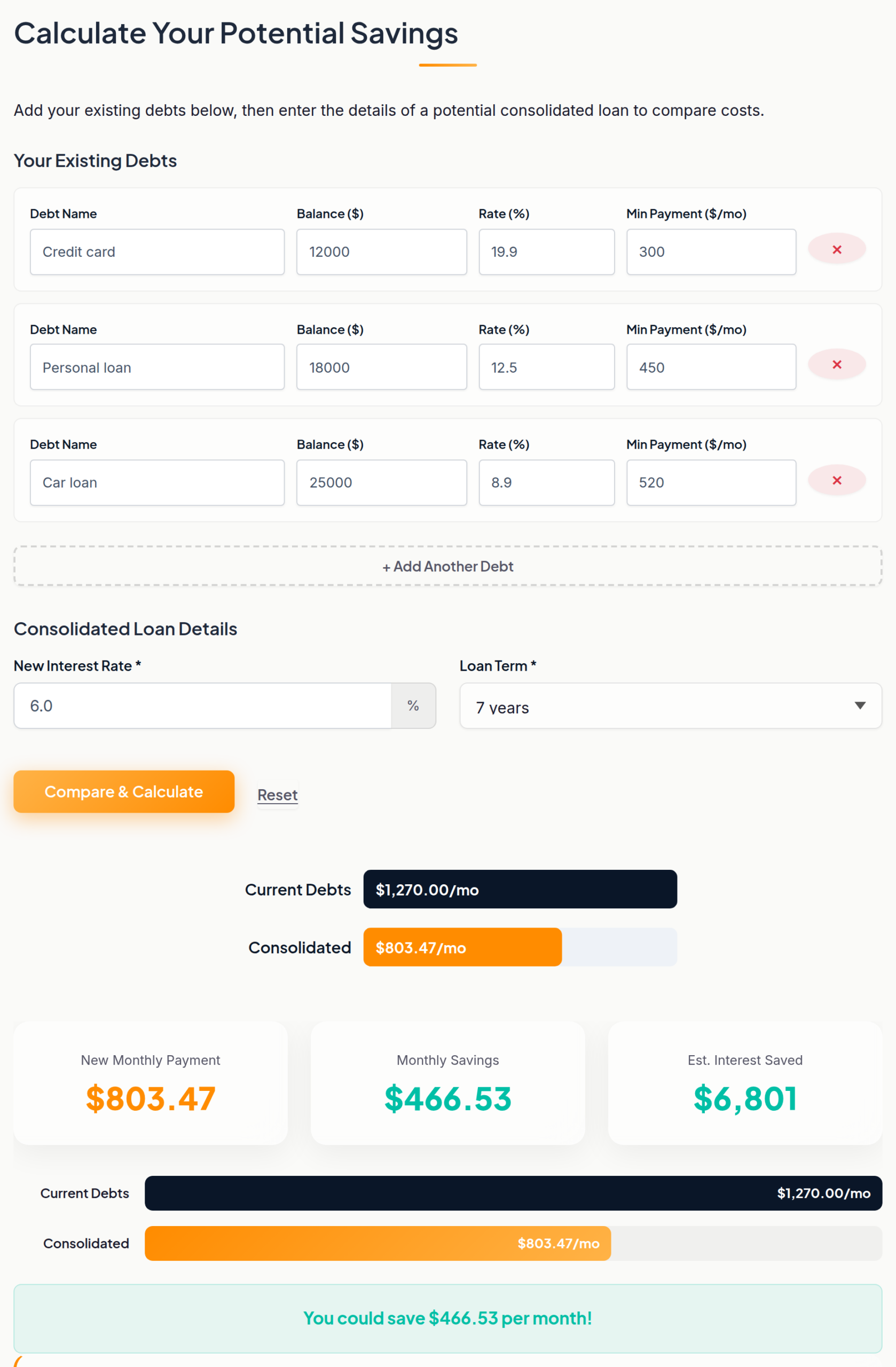
Walking through it, in the order you would fill it in:
- Add each debt as its own row. You need four things from each statement: a name, the balance owing, the interest rate, and the minimum monthly payment. Use “+ Add Another Debt” for each one. Do not round the rate — the difference between 12.5 and 19.9 per cent is the whole point of the exercise.
- Enter the consolidated loan details. The new rate is what you would pay on the consolidated loan, and the term is how long you would take to repay it. This is the field to think hardest about — seven years is entered here, not 25.
- Read the three result cards. New Monthly Payment $803.47, Monthly Savings $466.53, and Estimated Interest Saved $6,801.
The two bars above the cards make the cash flow change obvious: $1,270 a month currently, $803.47 after consolidating. The teal callout underneath states the monthly saving in plain terms.
Now change that Loan Term to 25 years and watch what happens. The monthly saving jumps — which looks like an improvement — but the interest saved figure collapses and turns against you. That single dropdown is the difference between saving $6,801 and losing more than $30,000. If you take one thing from this article, make it that.
Better cash flow and less total interest. That is what a good consolidation looks like.
The principle: consolidate at the lower rate, but keep the term close to what the original debts would have run. You capture the rate saving without paying for the extra decades.
How to Get That in Practice
If the debt goes into your 25-year home loan, the loan contract says 25 years. Structuring it so it does not actually take that long is the part that needs deliberate action:
- Keep paying the old amount. If you were paying $1,270 a month and the new minimum is $354, keep paying $1,270. The extra $916 comes straight off the principal and clears the consolidated amount in a few years. This is the simplest approach and it works — provided you actually do it.
- Ask for a split loan. Rather than absorbing the debt into the main loan, some lenders will set up a separate split over a shorter term. The shorter term is then contractual instead of relying on discipline. This is usually the better structure.
- Use an offset account. If your cash flow is irregular, parking surplus funds in offset reduces interest while keeping the money accessible.
When you model this in the calculator, enter the term you realistically intend to clear the debt in — not the term of your home loan. That gives you the honest comparison.
The Other Considerations
You are securing unsecured debt against your home
A credit card is unsecured. Rolled into your mortgage, it is secured against your house. If your circumstances change badly, the consequences of falling behind are materially more serious. This is the most important thing to understand before consolidating, and it is not a reason to avoid it — just a reason to be deliberate.
The costs of the transaction
Refinancing to consolidate can involve discharge fees, application and valuation fees, and possibly LMI if it pushes you above 80 per cent of the property’s value. Factor these in — they can absorb a fair chunk of the first year’s saving.
The behaviour question
Consolidation clears your card balances. If the cards then get used again, you have the original debt back plus a bigger mortgage. Every broker has seen this happen. Reducing or closing the limits at the same time is usually the right move — and it helps your borrowing capacity too, since cards are assessed on their limit rather than the balance.
When Consolidation Is Genuinely the Right Call
In my experience it works well when:
- You are carrying meaningful balances at high rates, particularly credit cards above 15 per cent.
- You have enough equity to consolidate without triggering LMI.
- Your income is stable and the problem is the rate, not a structural shortfall.
- You are prepared to keep repayments at the pre-consolidation level, or to structure a shorter split.
- You will reduce the credit limits rather than leave them open.
It works poorly when it is used to make an unaffordable situation feel temporarily affordable. If the underlying issue is that outgoings exceed income, consolidation postpones the problem and adds a mortgage to it. In that situation the honest advice is financial counselling first — the free National Debt Helpline service listed on the Australian Government’s Moneysmart site is a genuinely good starting point, and I will say so rather than write a loan.
Frequently Asked Questions
Does consolidating debt into your mortgage save money?
Not automatically. In the worked example, $55,000 of credit card, personal and car debt costs about $19,300 in interest if left alone. Rolled into a home loan at 6.00 per cent over 25 years, it drops the repayment by $916 a month but costs $51,310 in interest. Over seven years it saves $467 a month and costs about $12,500, around $6,800 less than doing nothing. The term decides it.
What loan term should I use when consolidating debt?
As a general principle, consolidate at the lower rate but keep the term close to what the original debts would have run. That captures the rate saving without paying interest for extra decades. When using the debt consolidation calculator, enter the term you realistically intend to clear the debt in, not your full home loan term, and compare total interest as well as the monthly figure.
How do I pay off consolidated debt faster inside my home loan?
The simplest way is to keep paying the old amount. If you were paying $1,270 a month and the new minimum is $354, keeping repayments at $1,270 sends the extra $916 straight to principal. A split loan over a shorter term makes the faster payoff contractual rather than relying on discipline, and is usually the better structure. An offset account suits irregular cash flow.
What are the risks of consolidating credit card debt into a mortgage?
The biggest is that unsecured debt becomes secured against your home, so falling behind has more serious consequences. There are also transaction costs such as discharge, application and valuation fees, and possibly LMI if the loan goes above 80 per cent of the property’s value. And if the cleared cards get used again, you end up with the original debt back plus a bigger mortgage.
When is debt consolidation a bad idea?
It works poorly when it is used to make an unaffordable situation feel temporarily affordable. If outgoings exceed income, consolidation postpones the problem and adds a mortgage to it. In that situation, financial counselling is the better first step, and the free National Debt Helpline listed on the Australian Government’s Moneysmart site is a good starting point. Consolidation suits stable incomes where the problem is the rate.
Run Your Own Numbers
Start with the debt consolidation calculator, and model it twice — once over your full home loan term, once over the term you actually intend to clear it in. Compare the total interest, not just the monthly figure.
Then use the loan repayment calculator to see what keeping the higher repayment does to the payoff timeline.
Our debt consolidation page explains how we structure these, and I am happy to model a few scenarios with you before anything is applied for.
Want to talk through what this means for your situation? Call David on 0417 676 191 or get in touch via our contact form.
This article is general information only and does not take into account your objectives, financial situation or needs. Figures are illustrative and current as at the date of publication. Interest rates, lender policies and government scheme rules change — please seek advice specific to your circumstances before acting.
Ready to move forward?
Have questions about anything in this article? David from Rebus Finance can help with a free, no-obligation chat.