
The two biggest obstacles for first home buyers are the deposit and the upfront costs. There are two government measures currently in place that address both, and used together they can save a Newcastle buyer a very substantial sum.
Here is how each works in 2026, with the rules taken directly from the government sources.
1. NSW Stamp Duty: The First Home Buyers Assistance Scheme
Stamp duty — formally transfer duty — is usually the largest single upfront cost after the deposit. The NSW First Home Buyers Assistance Scheme removes or reduces it for eligible buyers.
The thresholds, which have applied since 1 July 2023:
| Property value | What you pay |
|---|---|
| Up to $800,000 | No transfer duty — full exemption |
| $800,000 to $1,000,000 | A concessional (reduced) rate |
| Above $1,000,000 | Standard rates, no first home buyer discount |
The saving at the top of the exemption band is meaningful — on an $800,000 purchase, standard transfer duty would run to roughly $30,000. That is money that stays in your pocket.
Note how sharply the benefit tapers. The difference between a $999,000 purchase and a $1,010,000 purchase is not $11,000 — it is $11,000 plus the entire concession you just lost. If you are shopping near that boundary, the maths deserves proper attention before you bid.
Eligibility conditions apply, including requirements that you have not previously owned residential property in Australia and that you move in within a set period and live there for a minimum term. Full criteria are on the Revenue NSW website.
See it for yourself
Our stamp duty calculator applies these rules directly. Here is a $780,000 established home in NSW with First Home Buyer set to “Yes”:
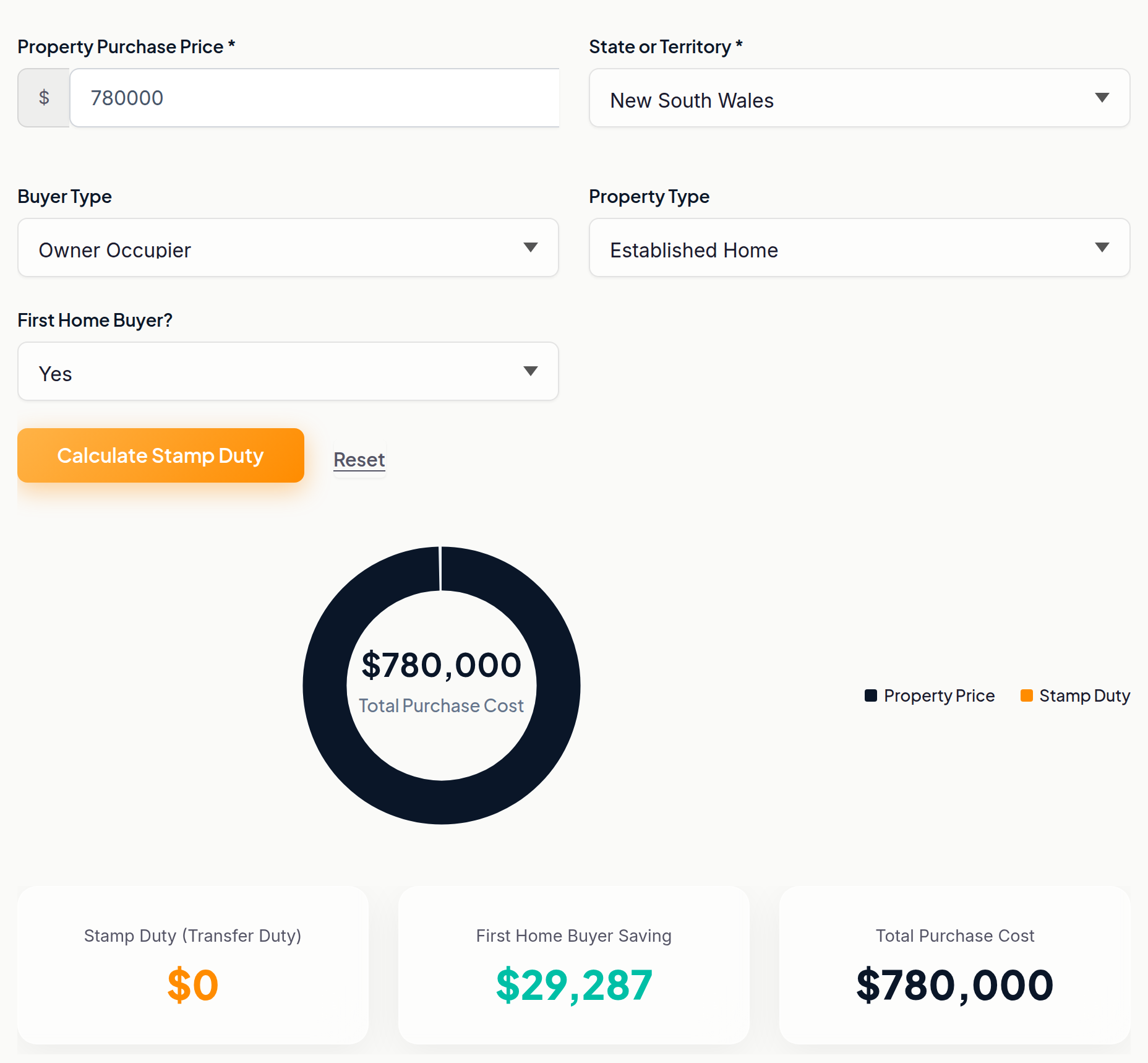
Three results, and the middle one is the important one:
- Stamp Duty (Transfer Duty): $0. Under the $800,000 threshold, so nothing is payable.
- First Home Buyer Saving: $29,287. This is what you would have paid without the exemption — nearly $30,000 that stays in your pocket.
- Total Purchase Cost: $780,000. The price with no duty added on top.
The single most useful thing you can do with this tool takes about five seconds: switch “First Home Buyer” between Yes and No and watch the numbers move. On this purchase, “No” produces $29,287 of duty payable. That is the concession made concrete.
It is also worth testing the thresholds yourself. Try $780,000, then $850,000, then $1,100,000, all with First Home Buyer set to Yes. You will see duty go from $0, to a reduced concessional amount, to $43,687 — the full exemption, then the concessional band, then no discount at all. Seeing that jump is the clearest possible argument for paying attention to where your offer sits relative to $800,000 and $1,000,000.
2. The Australian Government 5% Deposit Scheme
The federal scheme — previously known as the First Home Guarantee — lets eligible first home buyers purchase with as little as a 5 per cent deposit without paying lenders mortgage insurance. The government guarantees the balance to the lender. For single parents and eligible guardians, the minimum deposit is 2 per cent.
Two changes from 1 October 2025 made this considerably more useful, per Housing Australia:
- Places are now unlimited. The scheme previously ran on a capped number of places each financial year, which meant racing to secure one. That constraint is gone.
- Price caps increased substantially.
The Newcastle advantage
This is the part local buyers should pay close attention to. Under the current property price caps, NSW is split into two bands:
| Area | Price cap |
|---|---|
| NSW capital city and regional centres | $1,500,000 |
| NSW other areas | $800,000 |
Newcastle and Lake Macquarie are expressly designated regional centres for this purpose, alongside the Central Coast, the Illawarra, the Mid North Coast, Coffs Harbour-Grafton and Richmond-Tweed. That means the $1.5 million cap applies right across our region — not the $800,000 cap.
Both the purchase price and the lender’s assessed value of the property must sit at or below the cap.
What avoiding LMI is worth
Lenders mortgage insurance on a low-deposit loan commonly runs to tens of thousands of dollars, and it protects the lender rather than you. Avoiding it is one of the most concrete financial benefits available to a first home buyer, and it is the main reason this scheme is worth structuring your purchase around.
Using Both Together
The two measures are independent, so an eligible buyer can access both. A practical example for a Newcastle first home buyer purchasing at $780,000:
- Stamp duty: nil, because the purchase is under the $800,000 threshold.
- Deposit: 5 per cent — $39,000 rather than the $156,000 a 20 per cent deposit would require.
- LMI: nil, because the purchase is covered by the government guarantee.
The deposit is the barrier that stops most people, and this combination lowers it dramatically. You still need genuine savings, stable income and the capacity to service the loan — but the entry point is far more achievable than it looks from the outside.
Costs That Still Apply
Neither scheme covers everything. Budget for:
- Conveyancing or legal fees
- Building and pest inspections
- A strata report, if you are buying a unit or townhouse
- Loan application, valuation and settlement fees
- Council and water rate adjustments at settlement
- Moving costs, and connections
Allow a few thousand dollars beyond your deposit. Running out of cash at settlement is a stressful and entirely avoidable situation.
Borrowing Capacity Still Governs Everything
A smaller deposit requirement does not increase what you can borrow. Lenders still assess your income against their serviceability rules, including the 3 per cent buffer required under APRA’s standards — which means being tested at roughly three percentage points above your actual rate. We explain how that works in our guide to what lenders actually assess.
It is worth establishing your capacity before you start inspecting properties, so you are looking in the right price bracket from day one.
A Note on Timing
Government schemes change. Thresholds move, eligibility rules are revised, and programs are occasionally replaced. Everything above reflects the position as published at the time of writing, with links to the source pages so you can confirm the current rules yourself. Before you commit to a purchase, check the Revenue NSW and Housing Australia pages directly — or ask me and I will confirm where things stand.
Frequently Asked Questions
How much stamp duty do first home buyers save in NSW?
It can be more than $30,000. Under the First Home Buyers Assistance Scheme, eligible buyers pay no transfer duty up to $800,000, and standard duty on an $800,000 purchase would be roughly $30,000. On a $780,000 established home, a first home buyer pays $0 instead of $29,287. Between $800,000 and $1,000,000 a reduced rate applies, and above $1,000,000 there’s no first home buyer discount.
Can you use the 5% Deposit Scheme and the stamp duty exemption together?
Yes. The two measures are independent, so an eligible buyer can use both. For a Newcastle first home buyer purchasing at $780,000, that means no stamp duty, a 5 per cent deposit of $39,000 instead of the $156,000 a 20 per cent deposit would need, and no lenders mortgage insurance, because the government guarantee covers the loan. You still need genuine savings, stable income and the ability to service the loan.
Is Newcastle a regional centre for the 5% Deposit Scheme?
Yes. Newcastle and Lake Macquarie are expressly designated regional centres, so the $1,500,000 price cap applies across the region, not the $800,000 cap for other areas of NSW. The Central Coast, the Illawarra, the Mid North Coast, Coffs Harbour-Grafton and Richmond-Tweed are also regional centres. Both the purchase price and the lender’s assessed value of the property must be at or below the cap.
Does the 5% Deposit Scheme increase how much I can borrow?
No. A smaller deposit doesn’t change what a lender will lend you. Lenders still assess your income against their serviceability rules, including the 3 per cent buffer under APRA’s standards, which means testing you at roughly three percentage points above your actual rate. It’s worth knowing your borrowing capacity before you start inspecting, so you’re looking in the right price bracket. Our guide to what lenders actually assess explains how it works.
What costs do first home buyers still pay if they don’t pay stamp duty?
Neither scheme covers everything. Budget for conveyancing or legal fees, building and pest inspections, a strata report if you’re buying a unit or townhouse, loan application, valuation and settlement fees, council and water rate adjustments at settlement, and moving and connection costs. Allow a few thousand dollars beyond your deposit, because running out of cash at settlement is stressful and entirely avoidable.
How I Help First Home Buyers
Not every lender participates in the 5% Deposit Scheme, and those that do apply their own credit policies on top of the scheme rules. Part of my job is matching you to a participating lender whose policies suit your income and deposit situation, and making sure the application is structured correctly from the outset.
I also help with the sequencing — pre-approval before you start looking, so you can bid or negotiate with confidence rather than hoping the finance comes together afterwards.
If you are just beginning, our first home buyer guide covers the process end to end, and the first home buyer loans page explains how we work.
Want to talk through what this means for your situation? Call David on 0417 676 191 or get in touch via our contact form.
This article is general information only and does not take into account your objectives, financial situation or needs. Figures are illustrative and current as at the date of publication. Interest rates, lender policies and government scheme rules change — please seek advice specific to your circumstances before acting.
Sources
- Revenue NSW, First Home Buyers Assistance Scheme.
- Housing Australia, Unlimited places, higher property price caps for first home buyers from 1 October 2025.
- Australian Government, 5% Deposit Scheme — Property Price Caps.
- Australian Prudential Regulation Authority, APG 223 Residential Mortgage Lending.
Ready to move forward?
Have questions about anything in this article? David from Rebus Finance can help with a free, no-obligation chat.