
There is a gap in most people’s home loan planning, and it sits between two numbers: the income a lender assesses, and the money that actually arrives in your account.
Lenders work from gross income. You make repayments from net income. Our pay calculator and income tax calculator exist to close that gap, and used before you apply they will tell you something a borrowing power calculator cannot.
Start With What Actually Lands in Your Account
The pay calculator takes your salary and returns your take-home pay, with a per-period breakdown. Four of its inputs deserve attention.
Salary and pay frequency
Enter your gross salary and choose annual, monthly, fortnightly or weekly. Set the frequency to match how you are actually paid — it makes the output directly comparable to your bank statements, which is the point.
“Salary includes super?” — check your contract
This toggle changes the answer materially, and a surprising number of people get it wrong.
If your contract says “$120,000 plus superannuation”, super is paid on top and your salary for tax purposes is $120,000. If it says “$120,000 package including super”, the super comes out of that figure and your actual salary is meaningfully lower.
Same headline number, quite different take-home pay. If you are not certain which applies to you, check your employment contract or a recent payslip before you rely on the result.
Super rate
The compulsory rate is set by legislation and has been rising in steps. The calculator lets you enter it directly so the result stays accurate as it changes — you can confirm the current rate on the ATO website. If you salary sacrifice additional super, that reduces your take-home pay further and is worth accounting for separately.
What It Looks Like Filled In
Here is the pay calculator with a $95,000 salary entered, super paid on top, and a HECS-HELP debt:
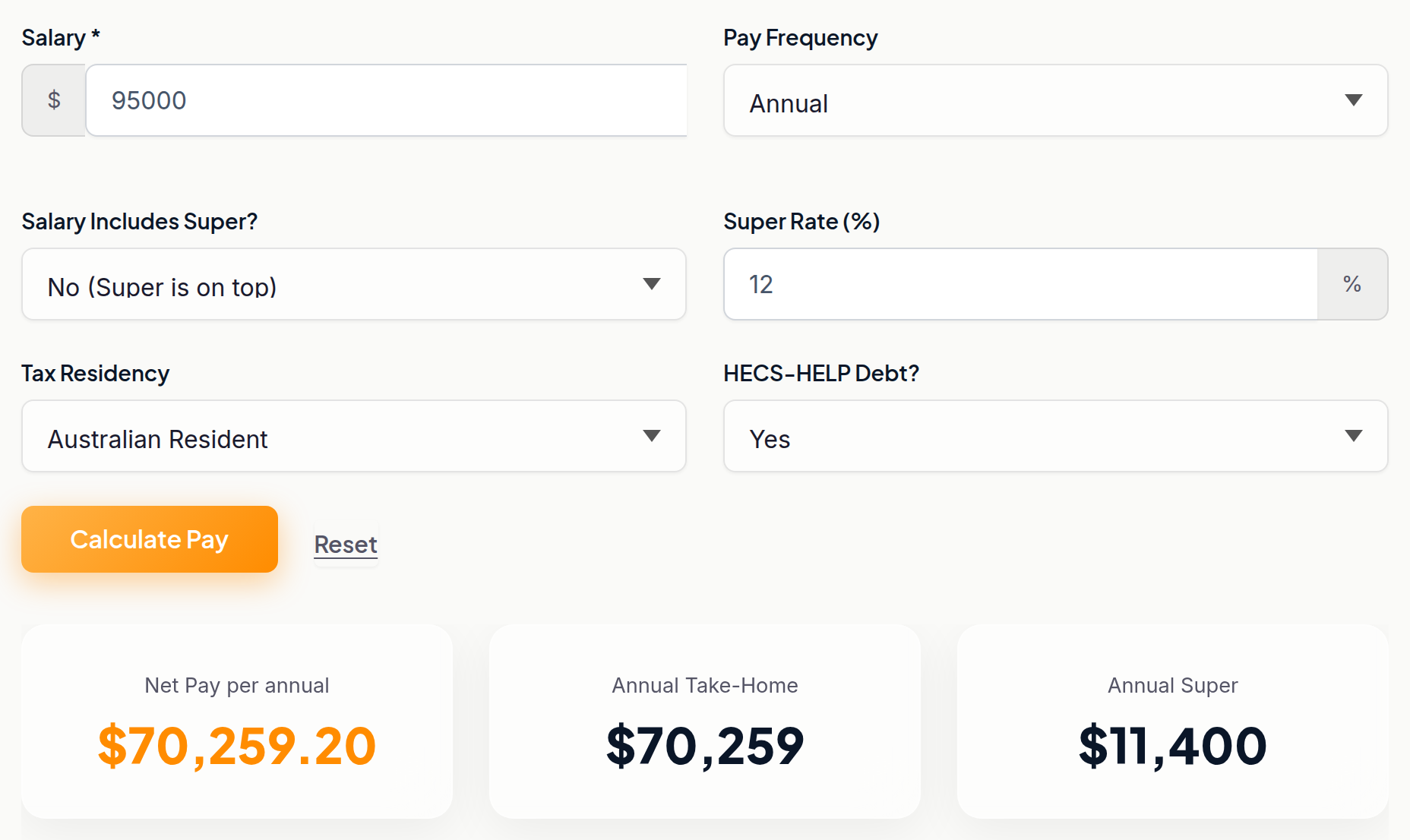
The number that matters for a home loan is Annual Take-Home: $70,259.
Sit that next to the $95,000 you would tell someone you earn. The difference is $24,741 — income tax, the Medicare levy and the compulsory HECS-HELP repayment, all deducted before you see a cent.
That is the gap this article is about. A lender assessing you works from the $95,000. Your mortgage gets paid out of the $70,259, which is about $5,855 a month. When you are working out what repayment you can live with, $5,855 is the number to budget against — not $7,917.
The third card, Annual Super $11,400, is your employer’s contribution going to your superannuation fund. It is real money, but you cannot spend it and it does not help you make repayments — so leave it out of your budgeting entirely.
HECS-HELP — the one that catches graduates out
Tick this if you have a study loan. Compulsory repayments are calculated on your income and deducted through your pay, and they reduce your take-home pay before you have made a single mortgage repayment.
The way this is calculated changed recently, and it is worth understanding. Repayments used to be a flat percentage of your entire income once you crossed the threshold — which created a nasty cliff, where earning one dollar more could cost you hundreds. Since the 2025-26 year it works marginally, like income tax: for 2026-27 you repay 15c for each $1 of income above $69,528, rising to 17c above $129,717. On a $95,000 salary that is about $3,821 a year. You can confirm the current thresholds on the ATO website.
They also reduce your borrowing capacity, because lenders treat the repayment as a committed expense. For borrowers with a small remaining balance, paying it out before applying can improve capacity — though whether that is worthwhile depends on the balance and what else the money could do, so it is worth checking rather than assuming.
Then Understand How the Tax Is Calculated
The income tax calculator takes a taxable income and shows the tax breakdown, and it lets you select the financial year — useful when you are looking back at a prior year’s return.
The concept worth taking from it is the difference between your marginal and effective tax rates.
Australia uses a progressive system: income is taxed in bands, and each band has its own rate. Your marginal rate is the rate applied to your next dollar earned. Your effective rate is the total tax you pay divided by your total income — always lower, because your earlier income was taxed in lower bands.
People routinely conflate the two and conclude that a pay rise will leave them worse off. It will not. Only the income above each threshold is taxed at the higher rate. A raise always increases your take-home pay — just not by as much as the gross figure suggests.
For a mortgage application, the practical use is estimating what a pay rise, a second job, or a partner returning to work will genuinely add to your household’s net position. Run it before and after, and use the difference.
Putting the Three Calculators Together
Here is the sequence I would suggest before you speak to any lender:
- Pay calculator — establish your real take-home pay, per pay period.
- Subtract your actual living costs — go through three months of bank statements rather than estimating. Almost everyone underestimates, and lenders will compare your figure to a benchmark anyway.
- Decide what you are comfortable committing to a mortgage from what remains, leaving genuine room for savings and the unexpected.
- Loan repayment calculator — work backwards from that repayment to the loan amount it supports.
- Borrowing power calculator — see what a lender would likely approve.
Then compare the figures from steps 4 and 5.
Why the Two Numbers Differ — and Which One to Trust
Step 5 is almost always the larger number. That is not an error in either tool; they are answering different questions.
The borrowing power calculator answers “what would a lender approve?” It applies lender logic, including the 3 per cent serviceability buffer that regulated lenders must apply — meaning you are tested at roughly three percentage points above your actual rate. We explain that in detail in what lenders actually assess.
Step 4 answers a different question: “what repayment do I actually want to live with?”
A lender’s approval confirms you could service the loan under stress. It says nothing about whether you would enjoy the next decade doing it. Approval is a ceiling; the number from step 4 is your target.
When those two figures are close, you are planning sensibly. When the approval is dramatically higher, treat that as information rather than an invitation.
A Note on Accuracy
These calculators are estimating tools. They do not account for salary packaging, fringe benefits, investment income, deductions, the Medicare levy surcharge, private health insurance offsets, or any of the individual circumstances that shape a real tax position.
For anything beyond a planning estimate — particularly if you are self-employed, have investment income, or salary package — check the ATO’s own calculators or speak to your accountant. I am a mortgage broker, not a tax adviser, and the line between the two matters.
Frequently Asked Questions
Do lenders use gross or net income for a home loan?
Lenders assess your gross income, but you make repayments from your net, take-home pay. That gap matters. On a $95,000 salary with super paid on top and a HECS-HELP debt, take-home pay is about $70,259 a year, or roughly $5,855 a month on FY 2026-27 rates. When budgeting for a repayment you can live with, work from the $5,855, not the $7,917 gross monthly figure.
What is the difference between a salary plus super and a package including super?
If your contract says “$120,000 plus superannuation”, super is paid on top and your salary for tax purposes is $120,000. If it says “$120,000 package including super”, super comes out of that figure and your actual salary is meaningfully lower. Same headline number, quite different take-home pay, so check your contract or a recent payslip before relying on any pay calculator result.
How much HECS do you repay on a $95,000 salary?
Since 2025-26, HECS-HELP repayments work marginally, like income tax. For 2026-27 you repay 15 cents for each dollar of income above $69,528, rising to 17 cents above $129,717. On a $95,000 salary that comes to about $3,821 a year. It is deducted through your pay, reducing take-home pay, and lenders also treat it as a committed expense when assessing borrowing capacity.
Will a pay rise put me in a higher tax bracket and leave me worse off?
No. Australia taxes income in bands, and only the income above each threshold is taxed at the higher rate. Your marginal rate applies to your next dollar earned; your effective rate is total tax divided by total income, and it is always lower. A raise always increases your take-home pay, just not by as much as the gross figure suggests.
Why is my borrowing power higher than what I can comfortably afford?
The two figures answer different questions. A borrowing power calculator applies lender logic, including the 3 per cent serviceability buffer, to show what a lender would likely approve. Working backwards from a repayment you are comfortable with shows what you actually want to live with. Approval is a ceiling, and your comfortable repayment is the target. If the approval is dramatically higher, treat it as information rather than an invitation.
What This Preparation Buys You
Clients who arrive having done this are noticeably easier to help. They know their net income, they know what repayment they are comfortable with, and they have a realistic price bracket. That means we can go straight to matching them with lenders whose policies suit their situation, rather than starting with guesswork.
It also means fewer wasted applications. Every credit enquiry leaves a mark on your file, and a string of declines makes the next lender more cautious.
You will find all of the tools together on our financial calculators page.
Want to talk through what this means for your situation? Call David on 0417 676 191 or get in touch via our contact form.
This article is general information only and does not take into account your objectives, financial situation or needs. Figures are illustrative and current as at the date of publication. Interest rates, lender policies and government scheme rules change — please seek advice specific to your circumstances before acting.
Ready to move forward?
Have questions about anything in this article? David from Rebus Finance can help with a free, no-obligation chat.